Wall Sit: How to Do It, Benefits and How Long to Hold It
Updated November 17, 2026 · 12 minute read · Free PDF
A wall sit, also called a wall squat, is a squat you hold still with your back flat against a wall. It needs no equipment, it has no impact, and it burns within a minute. It is also one of the best studied exercises for blood pressure: in a 2023 review of 270 trials, holds like this lowered blood pressure more than any other kind of training, and the wall sit ranked first of all single exercises for the top number. Here is how to do one, how long people really hold it, what it does, and workouts from your first 20 seconds to four holds of 2 minutes.
The short answer
How to do it: stand with your back on a wall and your feet about 60 cm (2 feet) out, then slide down until your thighs are level with the floor and your knees are right over your ankles. Keep your back flat on the wall and keep breathing. How long to hold it: start with 20 to 30 seconds, or sit higher, and add a few seconds each session. In two 2026 studies, active young adults held a wall sit for about a minute and a half on average. For blood pressure: the studied routine is 4 holds of 2 minutes with 2 minutes of rest, 3 times a week, at a height that gets hard by the last hold.
How to do a wall sit
- Back on the wall. Stand with your back flat against a smooth wall, feet hip width apart and about 60 cm (2 feet) in front of you.
- Slide down. Lower yourself until your thighs are level with the floor, hips and knees at about 90 degrees. Move your feet as you go so your shins stay vertical, knees right over your ankles.
- Set the position. Back and head on the wall, weight through your heels, knees pointing the same way as your toes. Arms hang at your sides or cross on your chest, never pushing on your thighs.
- Breathe. Keep breathing all the way through. Holding your breath pushes your blood pressure up even further, and a wall sit already raises it a lot.
- Get out. Slide back up the wall, or walk your feet in and stand. Shaky legs afterwards are normal.
Too hard? Sit higher. The less your knees bend, the easier the hold. In one study, heart rate and blood pressure rose steadily as people went from a shallow sit down to thighs level (Goldring and colleagues, 2014). Sit higher on day one and work lower over the weeks.
Common mistakes: feet too close to the wall, so your knees push out past your toes; hands resting on your thighs, which takes the weight off your legs; heels lifting; knees falling in; and holding your breath.
Wall sit muscles worked
Mostly the quadriceps, the four muscles on the front of your thigh. They stop your knees from bending further, so they carry the hold. Your glutes help hold your hips, your calves keep your shins still, and your core keeps your back flat on the wall. The burn builds fast in the front of the thighs because the muscle stays tense the whole time, with no moment to relax between reps.
Wall sit benefits
- Lower blood pressure. The best studied benefit by far, with the numbers below.
- Stronger, more enduring thighs, with no equipment. A review of isometric training found holds build strength and muscle at a wide range of efforts. Holds with the muscle at a longer length, which in a wall sit means sitting lower, built more muscle and carried over better to moving exercises (Oranchuk and colleagues, 2019).
- Gentle on the joints, if you pick the height. No impact and no twisting. The deeper you sit, the more the kneecap is loaded, so a higher sit suits sore knees (more in the questions below).
- Small and quick. A wall, a timer and a few minutes. Even the full blood pressure routine takes under 15 minutes.
What a wall sit does not do is replace squats. A hold trains your legs at one angle, so keep moving exercises in your week too.
How long to hold a wall sit
It depends on how low you sit and what you train for. Here is what research measured, and how to read your own time.
What people hold. Two 2026 studies had physically active young adults hold a wall sit, thighs level, until they could no longer keep the position. The 42 students in one, 21 years old on average, held for 88 seconds on average (Washmuth and colleagues, 2026). The 60 active adults in the other held for 97 seconds (Daou and colleagues, 2026).
| Under 30 seconds | Starting out. Train with shorter holds, or sit higher. |
|---|---|
| 30 to 60 seconds | Building. Keep adding 5 seconds a session. |
| 60 to 90 seconds | Close to the averages of active young adults in the studies, 88 and 97 seconds. |
| 90 seconds to 2 minutes | Above those averages. |
| Over 2 minutes | Well above them. Time to make it harder: sit lower, add weight or try one leg. |
Is there a good wall sit time by age? We could not find a single study with wall sit standards by age, or for men and women separately. The chart many sites copy (over 100 seconds is excellent for men, over 60 for women) comes from Topend Sports, and it is for a different test: a wall sit on one leg, with the other foot lifted. Its author based it on their own experience, not on a study. The fairest test is your own last time.
To train, hold for time, not to failure. Find your max once. Then do 3 to 5 holds of about half of it, with 1 to 2 minutes of rest, and add 5 seconds to each hold every session. Test your max again every 2 weeks.
To hold longer on test day, look outward. In one of the studies, people held 107 seconds while they focused on a strip of tape on the wall in front of them, against 97 seconds when they focused on their legs (Daou and colleagues, 2026). In the other, silently repeating a swear word every 5 seconds added about 18 seconds: 106 against 88 (Washmuth and colleagues, 2026).
Free PDF. The form steps, the hold times above, the variations and the safety points are on page 2, ready to print. Download it
Wall sit for blood pressure
This is where the wall sit stands out. In 2023, researchers pooled 270 trials with 15,827 people to compare every kind of exercise training on resting blood pressure (Edwards and colleagues, 2023). The average drops, top number over bottom number, in mmHg:
| Isometric training: holds like the wall sit | 8.24 / 4.00 |
|---|---|
| Aerobic and strength combined | 6.04 / 2.54 |
| Strength training with weights | 4.55 / 3.04 |
| Aerobic exercise | 4.49 / 2.53 |
| HIIT | 4.08 / 2.50 |
Of all the single exercises, the wall sit ranked first for lowering the top number, systolic pressure. Running ranked first for the bottom one.
The routine the studies used: 4 holds of 2 minutes with 2 minutes of rest, 3 times a week with a day off between sessions, for 4 weeks.
- 28 healthy men with normal blood pressure, training at home: down 4/3 mmHg, and resting heart rate down 5 beats a minute (Wiles and colleagues, 2017).
- 24 people with untreated stage 1 high blood pressure, 44 years old on average: down 12.4/6.2 mmHg at the clinic, and 11.8/5.6 over 24 hours of normal life (Taylor and colleagues, 2019).
- 30 adults with normal or slightly raised blood pressure: the group that picked its own height by feel at home dropped 9/6 mmHg, close to the 14/6 of a group whose height was set in a lab from heart rate (Lea and colleagues, 2024).
The European Society of Cardiology's 2024 guidelines on high blood pressure name the wall sit, with the plank and hand grip, as a way to add isometric training to aerobic exercise: three sets of 1 to 2 minute holds (McEvoy and colleagues, 2024).
Find your height by feel
The labs set each person's height from a heart rate test. The 2024 study showed you can find it without any equipment, by how hard the holds feel, rated from 0 (no effort) to 10 (as hard as it gets):
- Pick a height. Slide down to where you think a 2 minute hold would feel like about 4 out of 10, shins vertical. Put a small mark on the wall at the lowest point your back touches.
- Do the routine. 4 holds of 2 minutes at that mark, 2 minutes of rest. Rate each hold as it ends.
- Check the effort. The targets were about 4 after the first hold, 5.5 after the second, 7 after the third, and 8 to 9 after the fourth. Same height, rising effort.
- Adjust, then keep it. Too easy or too hard? Move the mark 1 to 2 cm next session. After a session or two, keep the same height for the rest of the 4 weeks.
Safety first. Blood pressure climbs a lot during the hold itself. In one study, a 2 minute wall sit with thighs level averaged 196/112 mmHg by the end, against 134/76 in a shallow sit with the knees bent only about 45 degrees (Goldring and colleagues, 2014). In another, the bottom number passed 115 mmHg, a common stop limit in exercise tests, in almost every healthy young adult within about 50 seconds, with no harm done (Jones and colleagues, 2026). A review of 24 trials in people with high blood pressure worked out 1 adverse event per 38,444 holds (Hansford and colleagues, 2021). If you have high blood pressure or a heart condition, or take medicine for either, ask your doctor before you start. Sit higher rather than lower, never hold your breath, and stop if you feel dizzy or get a headache or chest pain.
Free PDF. Page 3 turns this routine into a sheet: the height check, the effort targets and a log for all 12 sessions. Page 4 is a 4 week plan for longer holds. Download it
Wall sit workouts
| First wall sits | 3 holds of 20 to 30 seconds, as high as you need, with 1 minute of rest. Add 5 seconds a session. |
|---|---|
| Longer holds | Test your max, then 4 holds of half of it with 1 to 2 minutes of rest. Add 5 seconds a session and test again every 2 weeks. |
| Blood pressure | 4 holds of 2 minutes with 2 minutes of rest, 3 times a week with a day off between, at the height you found by feel. |
| Wall sit ladder | Holds of 30, 45, 60, 45 and 30 seconds with 30 seconds of rest: 3.5 minutes of holding in 5.5 minutes. More in ladder workouts. |
| Squat finisher | 20 bodyweight squats, then straight into a 30 second wall sit. Rest 1 minute, 3 rounds. See 100 squats a day. |
| 30 day challenge | One hold a day. Start at half your max and add 5 seconds a day. Miss the time? Repeat that day's time tomorrow. |
Rest between holds the way you would between hard sets: how long to rest between sets has the research.
Wall sit variations
| Easier | Sit higher, with your knees bent less. Shorter holds with more rest. |
|---|---|
| Weighted wall sit | A weight plate, dumbbell or kettlebell flat on your thighs, close to the hips. Start light and add a little at a time. |
| One leg | Lift one foot and hold on the other leg, then switch. Far harder, so start with short holds. |
| Marching | Lift one foot a few centimetres, put it down, then the other, without your hips moving. |
| Heel raises | Lift both heels and lower them slowly while you hold: calves and thighs together. |
| Ball squeeze | Squeeze a ball or a folded cushion between your knees. |
| Arms up | Hold a light weight overhead, or press dumbbells while you sit: shoulders join in. |
Common questions
Are wall sits as good as squats?
They do different jobs. A wall sit trains your thighs at one angle and builds the endurance to stay there. Squats train the whole range, from standing to the bottom, plus balance and power. Holds at longer muscle lengths carry over best to moving exercises (Oranchuk and colleagues, 2019), so if squats are your goal, sit low, and do both.
Are wall sits bad for your knees?
For most knees, no: there is no impact and no twisting, and you choose how far they bend. The deeper you sit, though, the harder the kneecap presses on the thigh bone. A lab study of the wall squat found more kneecap pressure with the knees bent 60 to 90 degrees, and suggested staying between 0 and 50 degrees of bend when the aim is to spare the kneecap (Escamilla and colleagues, 2009). So for sore knees, sit higher.
Do wall sits help with knee pain?
For pain at the tendon below the kneecap (patellar tendinopathy, or jumper's knee), holds can help. In a small study of six volleyball players, one session of heavy thigh holds eased the pain right away, for at least 45 minutes (Rio and colleagues, 2015). Larger trials since found holds and moving reps help about equally (van Ark and colleagues, 2016; Holden and colleagues, 2020). Pain that stays or gets worse needs a physiotherapist.
Can you do wall sits every day?
Yes, if most days are easy: a few holds well short of your max. Keep all-out holds and the 4 × 2 minute routine to 2 or 3 days a week with a day off between, as in the blood pressure studies.
Why do my legs shake during a wall sit?
Tired muscles lose the smooth control they had at the start, and the shaking shows it. It is normal and harmless. Stop when you can no longer hold the position, not when the shaking starts.
What is the wall sit world record?
11 hours, 51 minutes and 14 seconds, by Dr. Thienna Ho in San Francisco on 20 December 2008: the longest static wall sit listed by Guinness World Records.
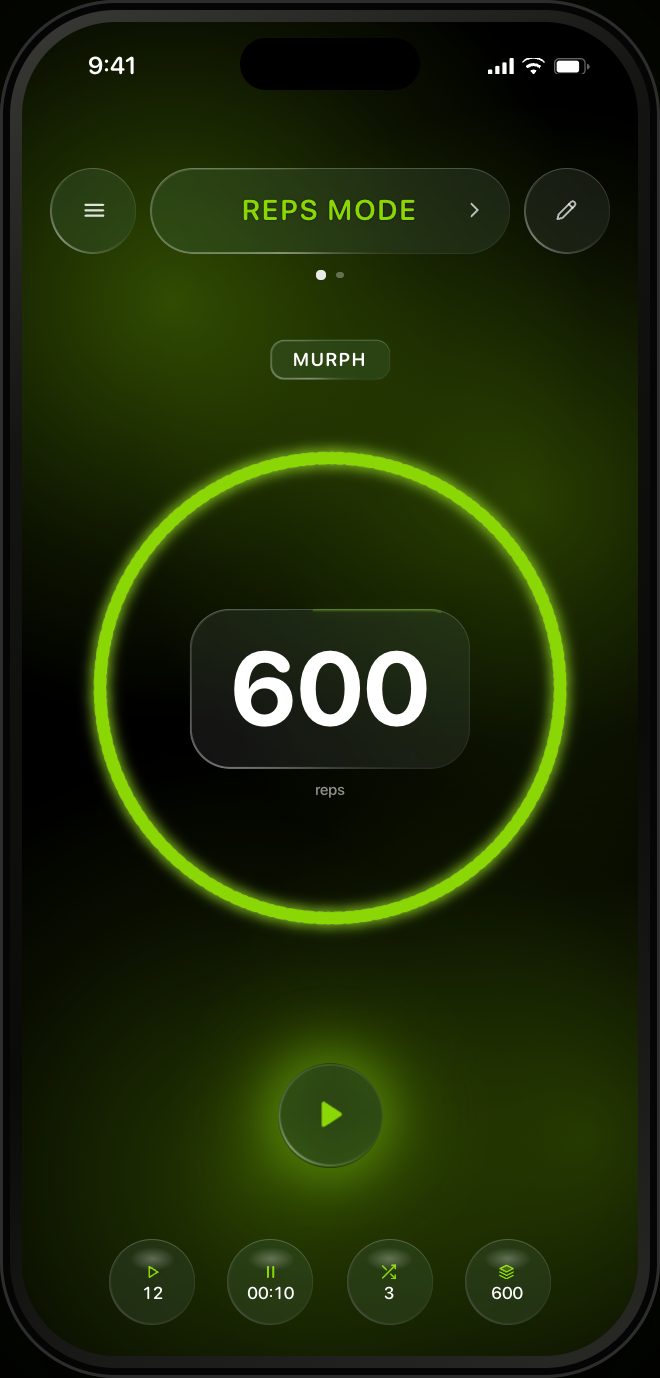
How to time your wall sits with RankTime
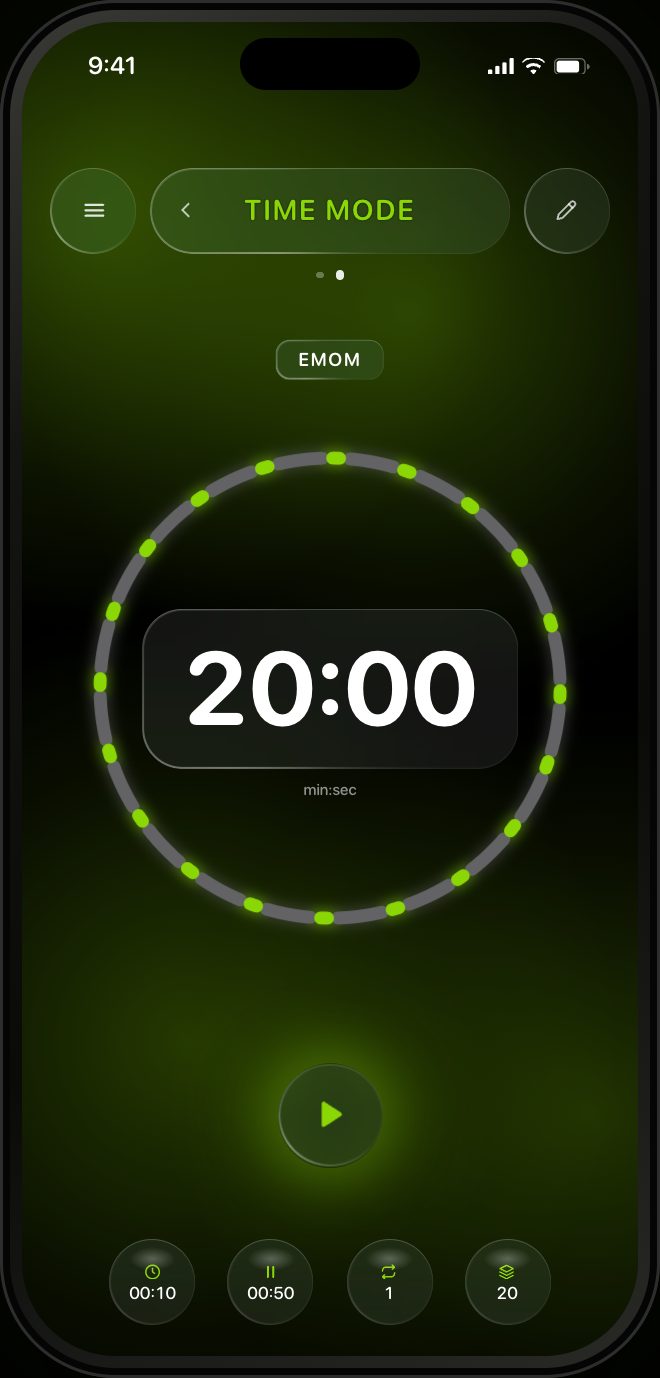
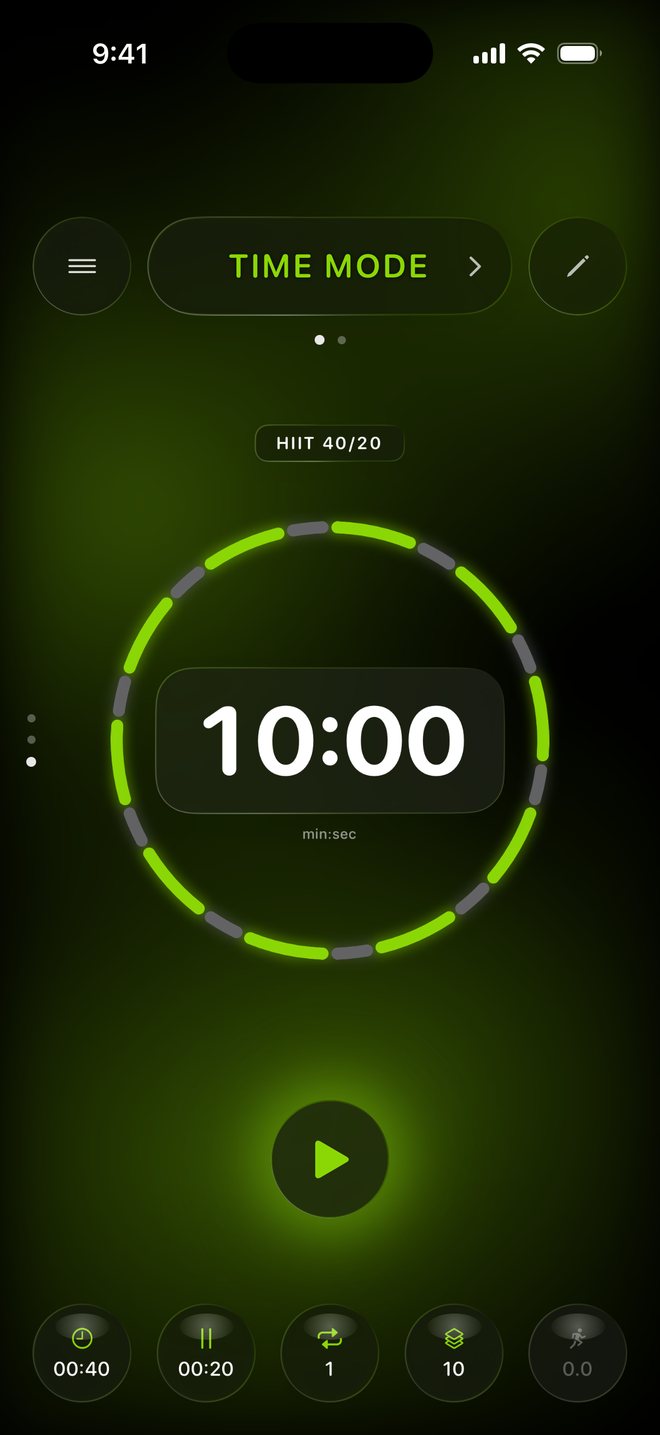
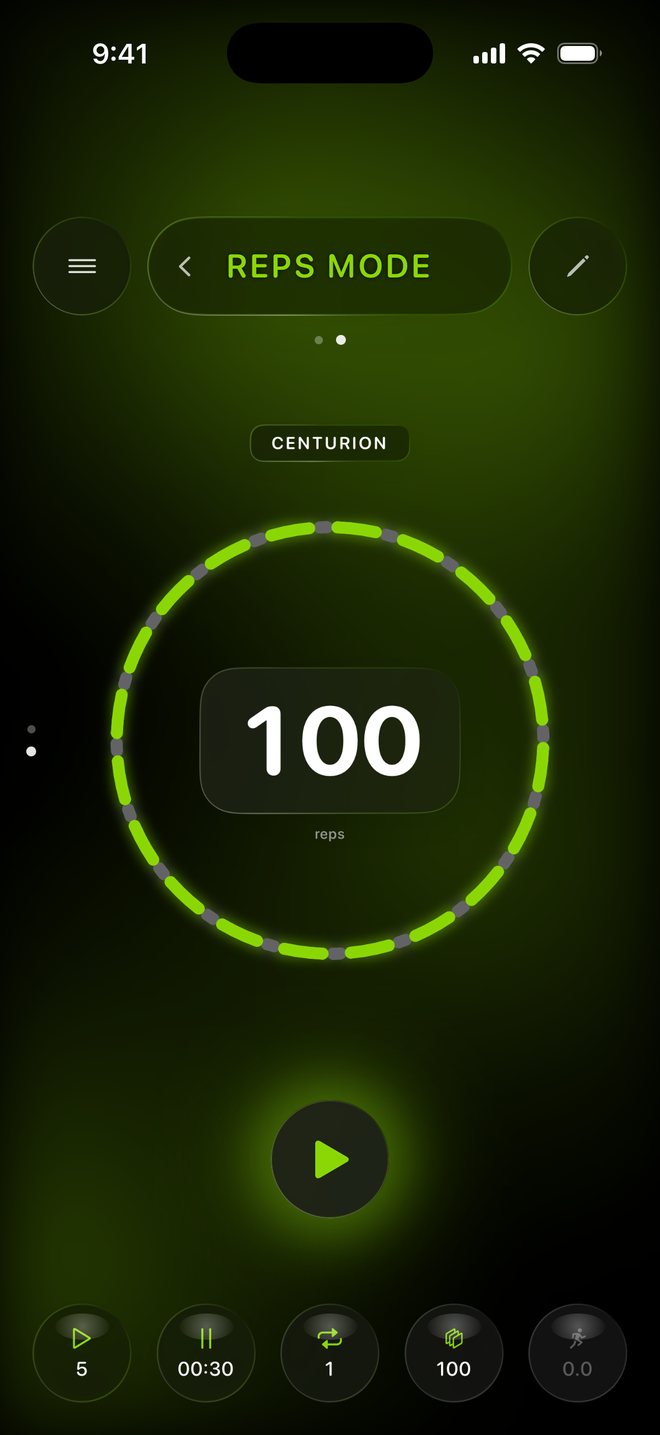
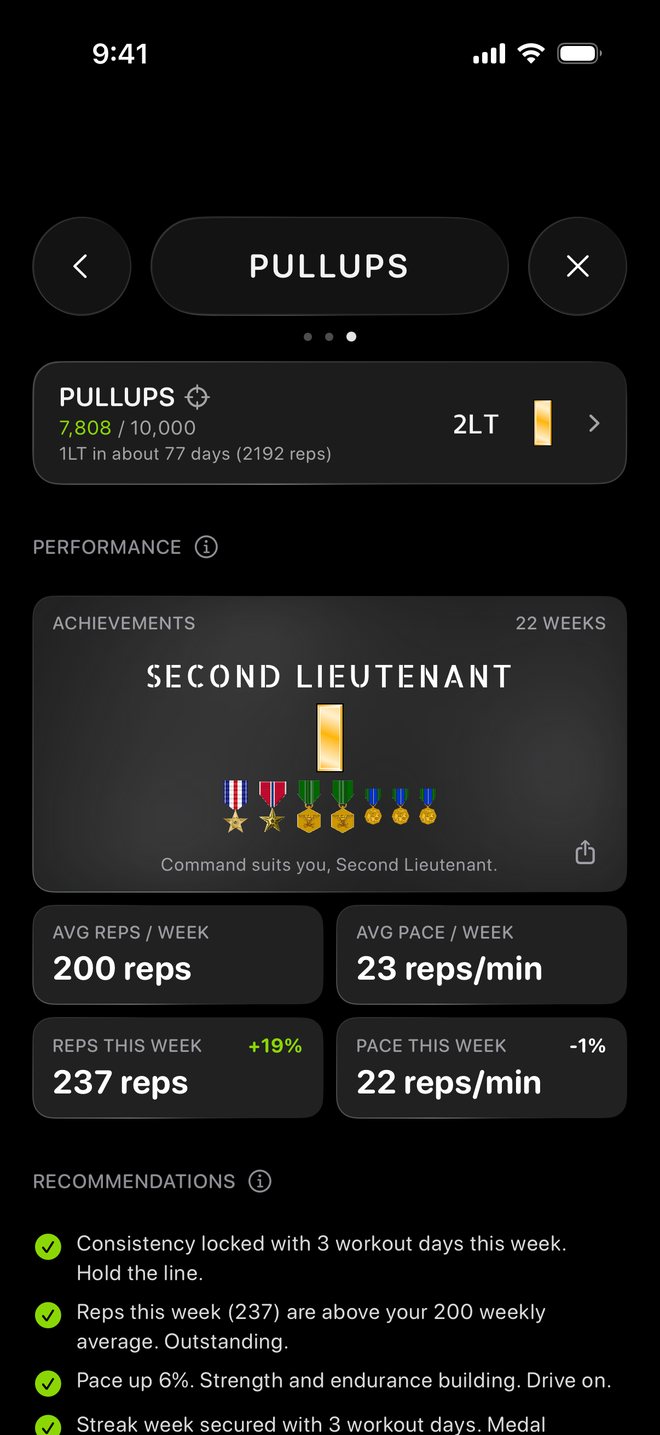
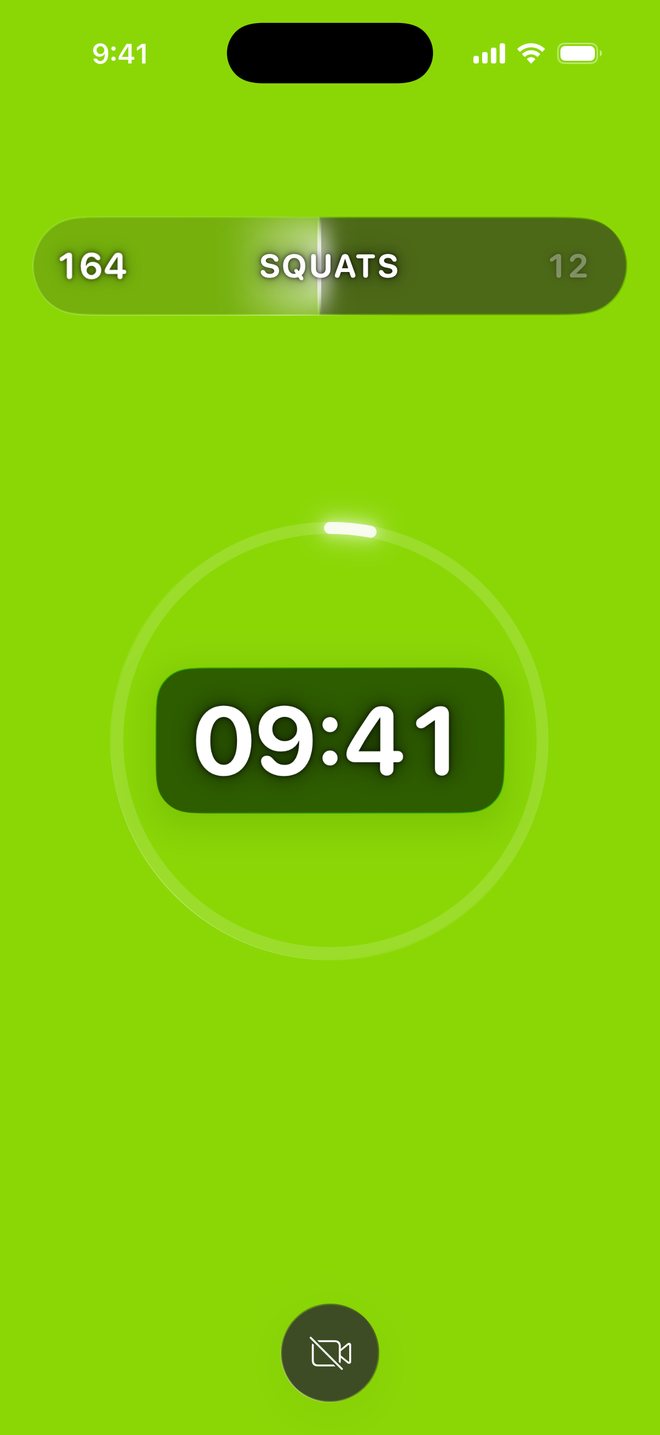
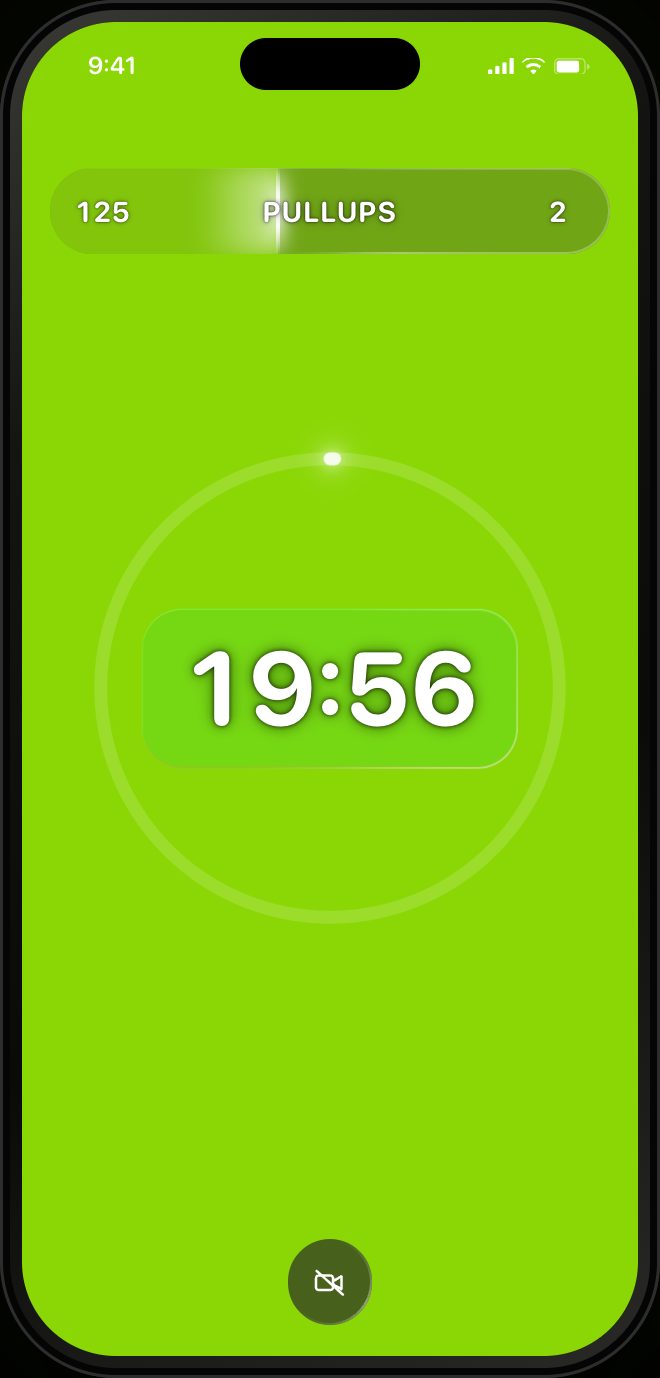
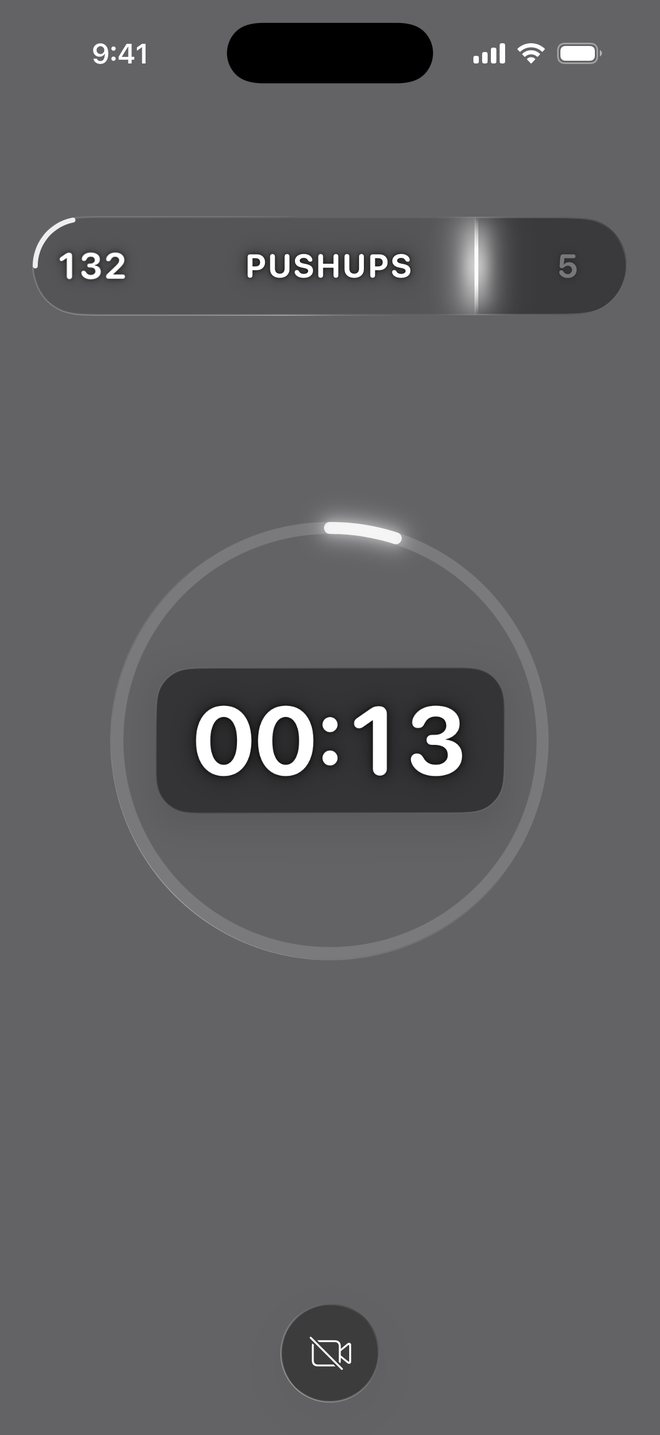
RankTime counts the wall sit with the camera, one of its six built-in holds. The clock runs only while the camera sees you in the hold. Stand up early and the screen turns red and the clock stops, and with the voice guide on you hear "Back in position". Two minutes on the clock is two minutes in the hold.
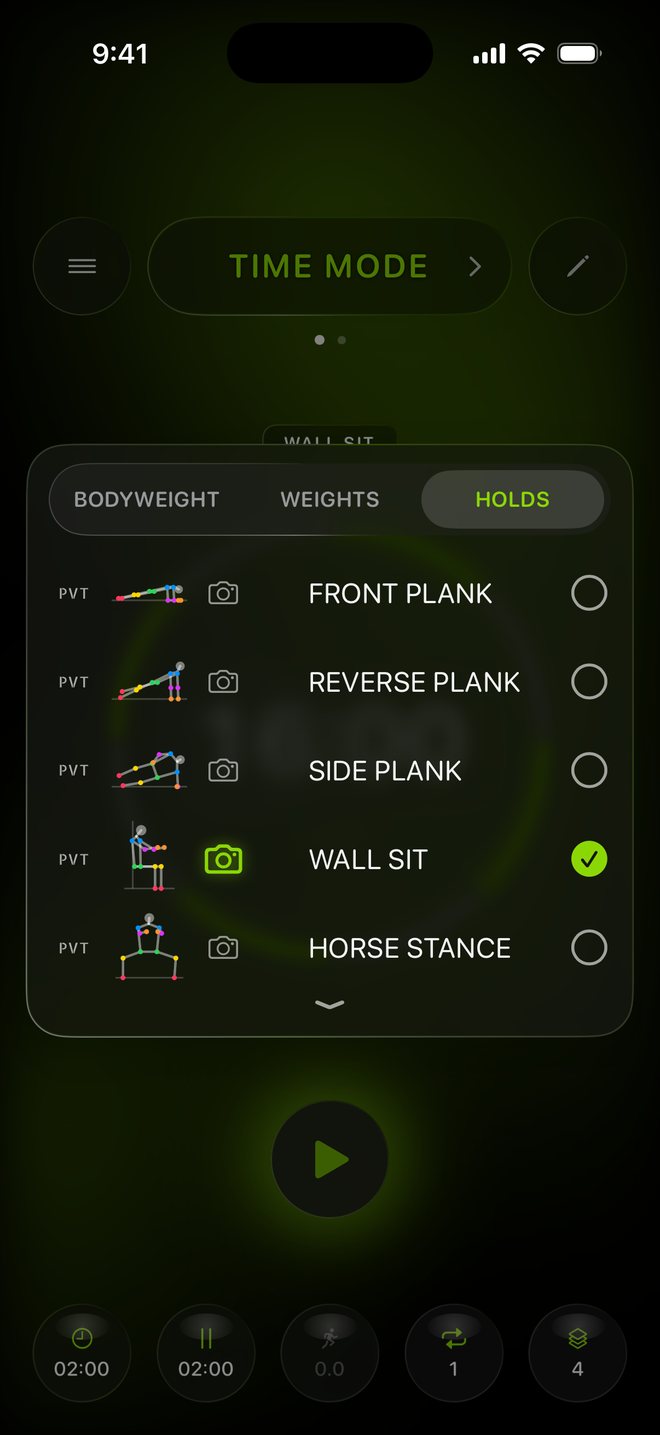
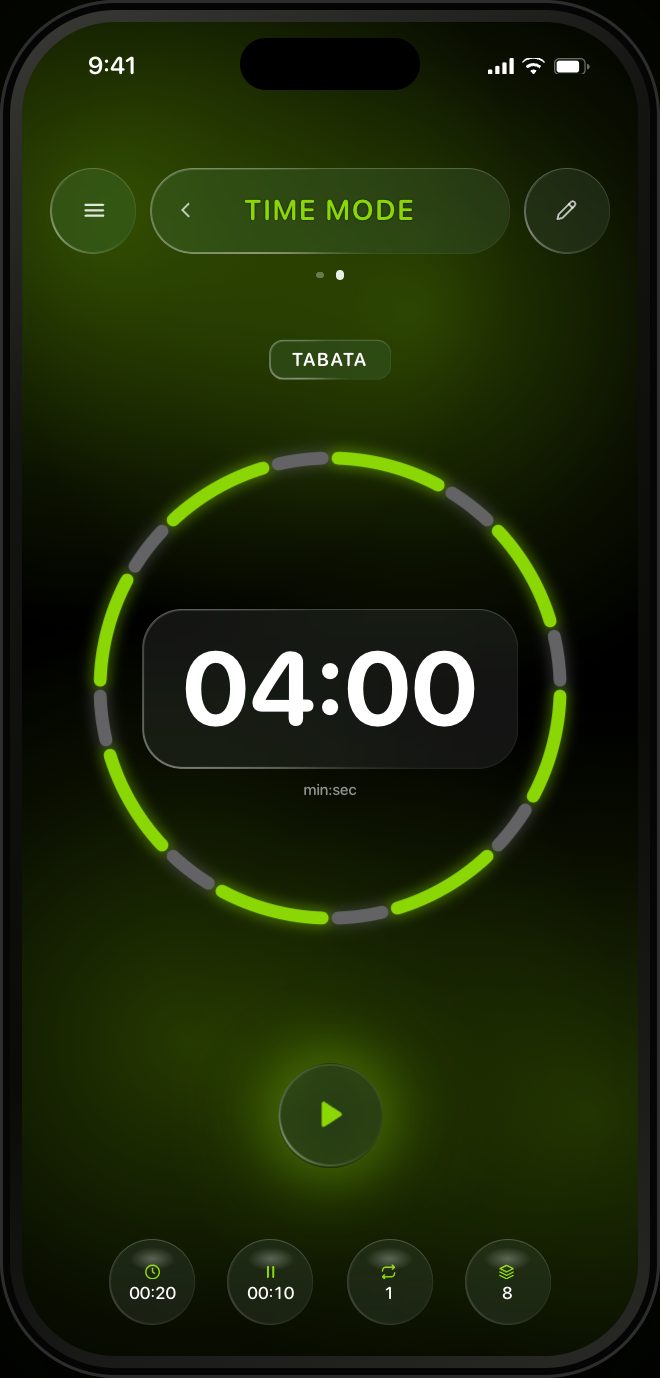
- Pick the hold. Swipe sideways to TIME. Tap the exercises circle, fourth from the left, then the exercise under the ring to open the list. On HOLDS, tick WALL SIT and untick the others.
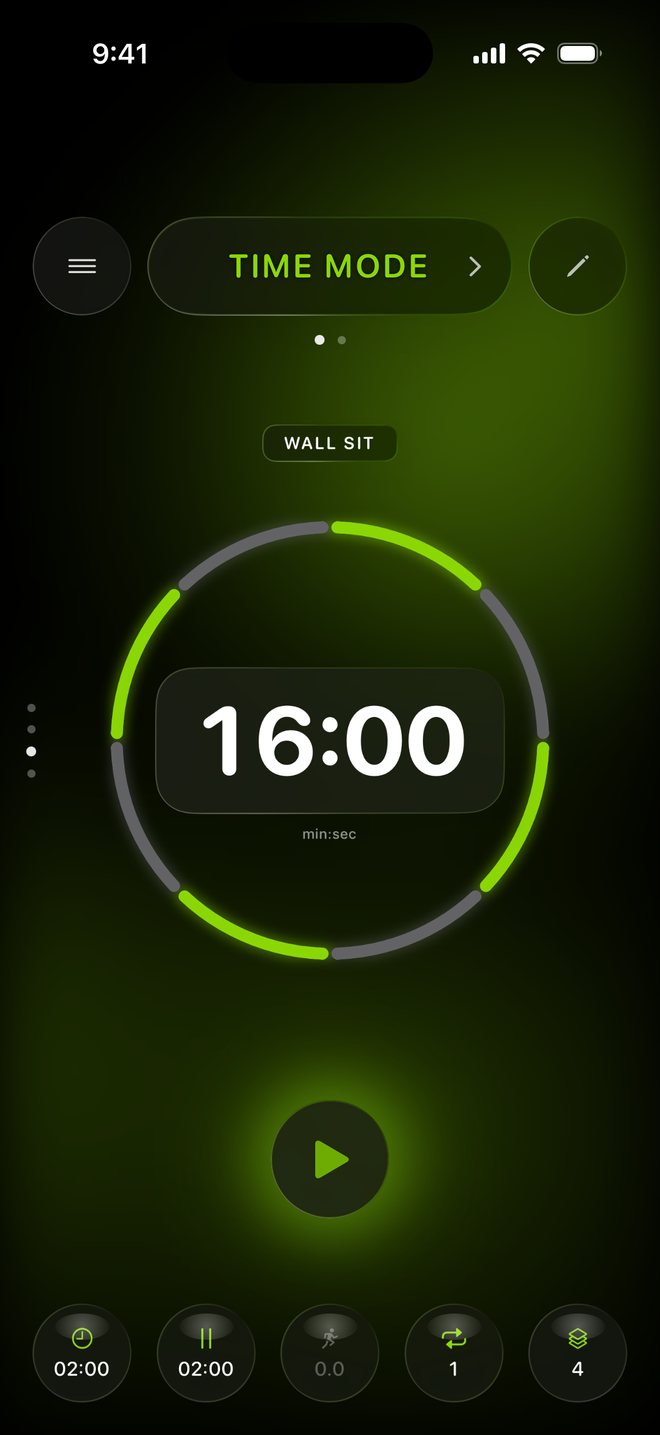
- Set the times. The first circle is how long each hold lasts, the second is the rest, the last is the number of rounds. Holds and rests go from 5 seconds to 10 minutes, in 5 second steps. For the blood pressure routine: 2:00, 2:00 and 4.
- Keep it. Once you change the page, the pencil at the top right turns into a tick, with a + under it. Tap the + and name it, say WALL SIT: it is saved as a new workout next to this one, a swipe up or down away.
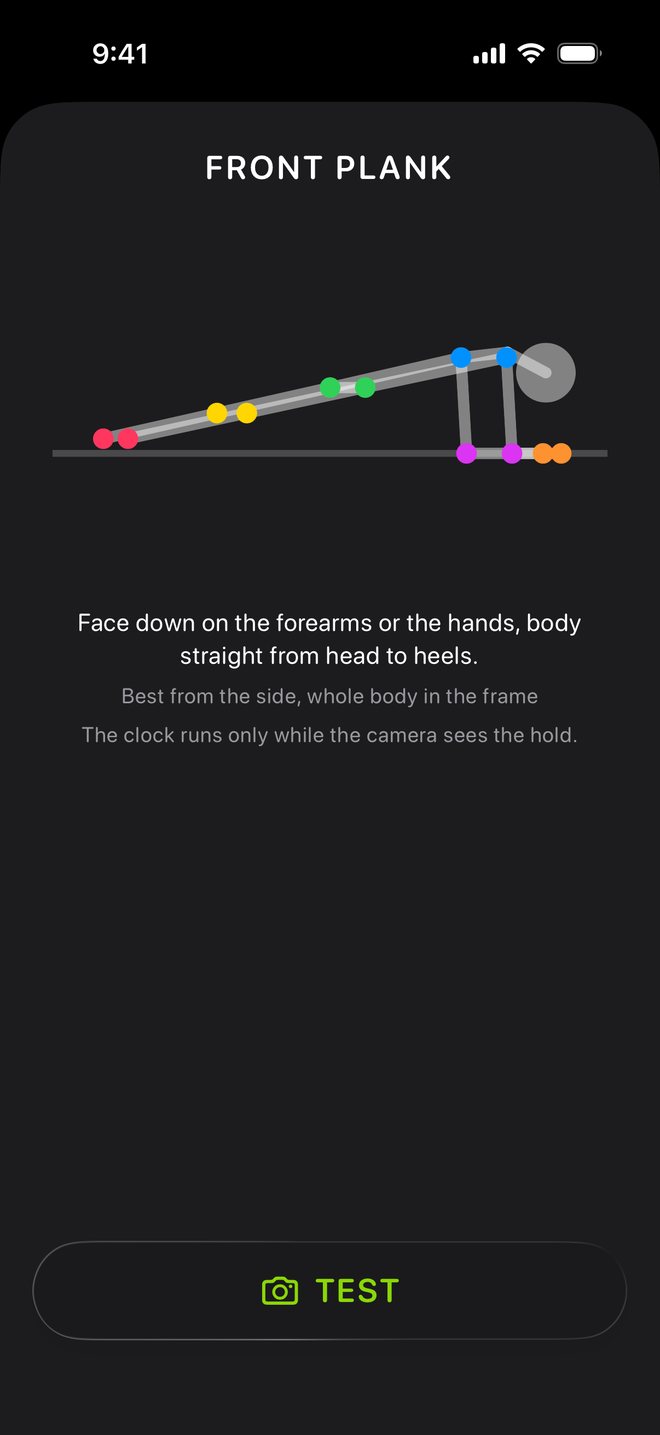
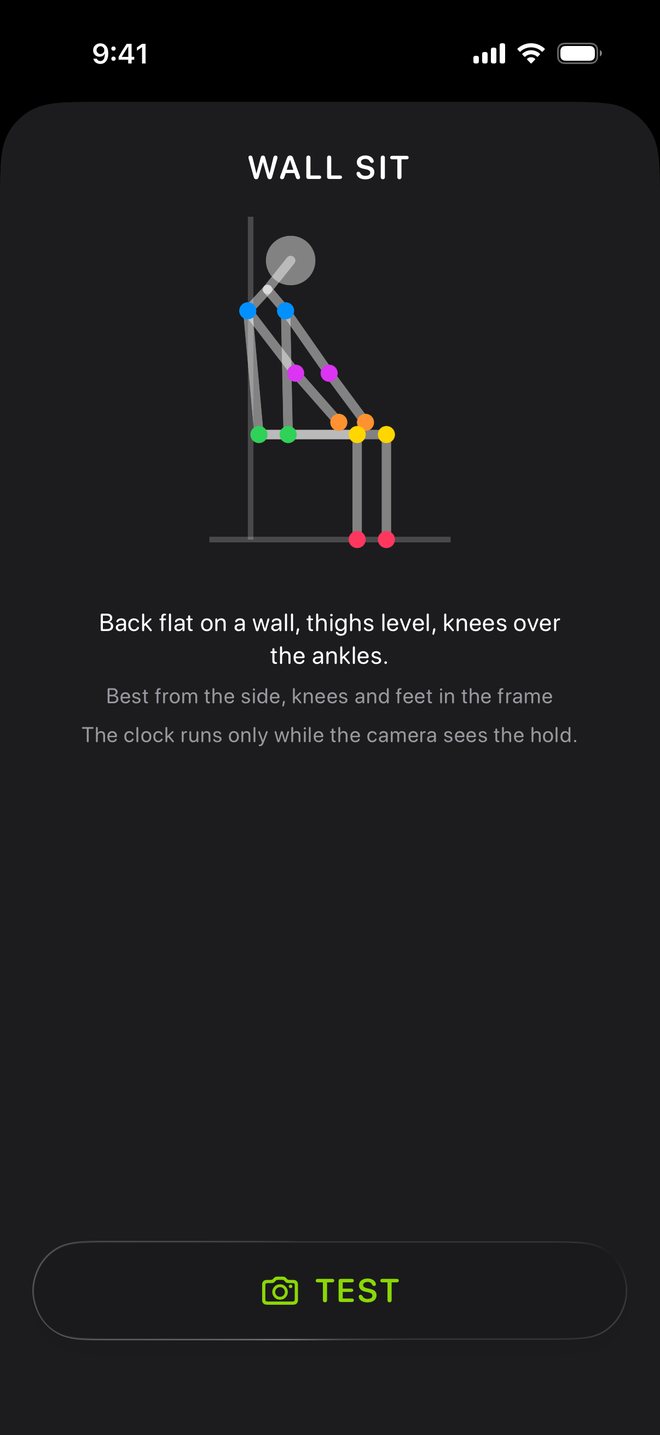
- Set up the phone. Stand it side-on, with your knees and feet in the frame. The camera turns on by itself when a workout has a hold. To check the spot first, open Trainer, HOLDS, WALL SIT and tap TEST: it counts the seconds held.
- Press play and hold. Each hold counts down only while you are in position, then the rest starts by itself.
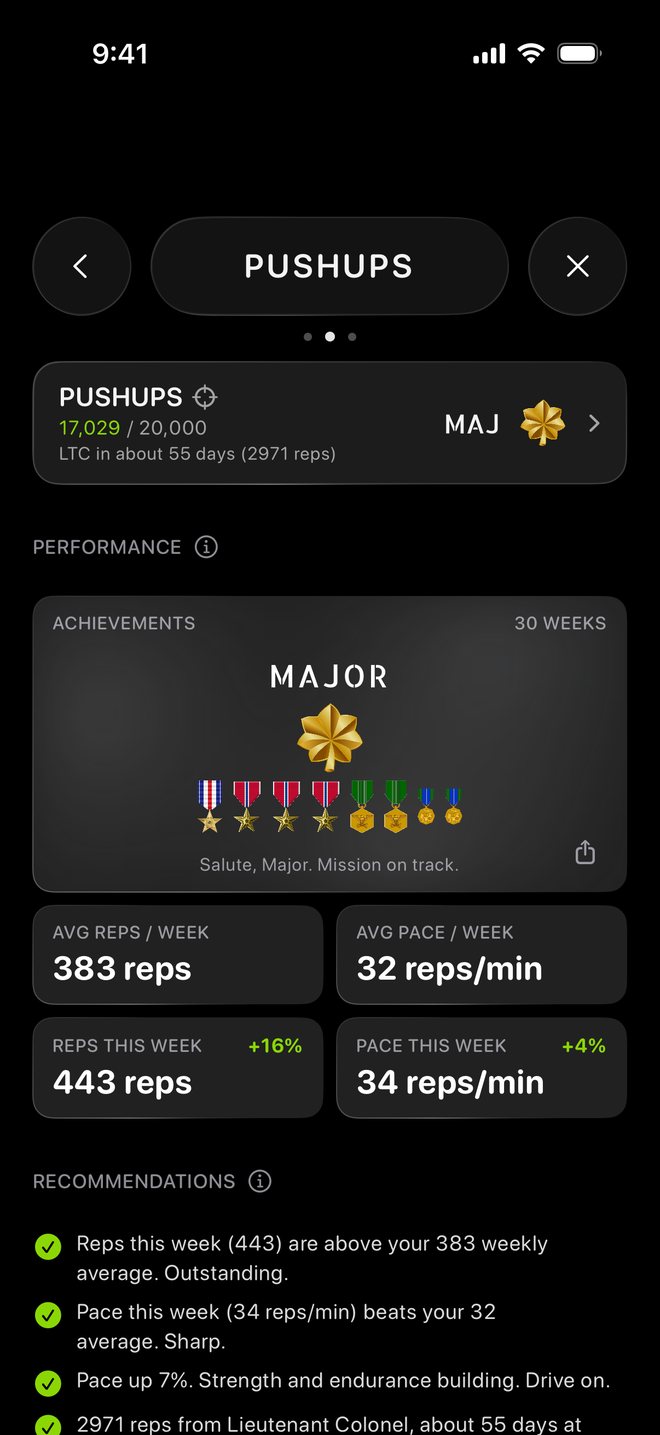
Every 2 seconds you hold count as a rep toward your WALL SIT rank, from Private to General of the Armies.
Sources
- Edwards JJ, Deenmamode AHP, Griffiths M, and colleagues. Exercise training and resting blood pressure: a large-scale pairwise and network meta-analysis of randomised controlled trials. British Journal of Sports Medicine, 2023.
- Wiles JD, Goldring N, Coleman D. Home-based isometric exercise training induced reductions resting blood pressure. European Journal of Applied Physiology, 2017.
- Taylor KA, Wiles JD, Coleman DA, and colleagues. Neurohumoral and ambulatory haemodynamic adaptations following isometric exercise training in unmedicated hypertensive patients. Journal of Hypertension, 2019.
- Lea JWD, O'Driscoll JM, Wiles JD. The implementation of a home-based isometric wall squat intervention using ratings of perceived exertion to select and control exercise intensity. European Journal of Applied Physiology, 2024.
- McEvoy JW, McCarthy CP, Bruno RM, and colleagues. 2024 ESC Guidelines for the management of elevated blood pressure and hypertension. European Heart Journal, 2024.
- Goldring N, Wiles JD, Coleman D. The effects of isometric wall squat exercise on heart rate and blood pressure in a normotensive population. Journal of Sports Sciences, 2014.
- Jones MD, Tan E, Woo J, and colleagues. Acute blood pressure responses to plank and wall sit isometric exercise in adults. Journal of Hypertension, 2026.
- Hansford HJ, Parmenter BJ, McLeod KA, and colleagues. The effectiveness and safety of isometric resistance training for adults with high blood pressure: a systematic review and meta-analysis. Hypertension Research, 2021.
- Washmuth NB, Jiannine L, Ballmann CG. Effects of inner monologue swearing on physical performance. International Journal of Exercise Science, 2026.
- Daou M, Gannon E, Winepol M, and colleagues. The positive impacts of external focus of attention on performance, fatigue, and affect on a fatiguing task. Frontiers in Psychology, 2026.
- Oranchuk DJ, Storey AG, Nelson AR, Cronin JB. Isometric training and long-term adaptations: effects of muscle length, intensity, and intent. Scandinavian Journal of Medicine and Science in Sports, 2019.
- Escamilla RF, Zheng N, Macleod TD, and colleagues. Patellofemoral joint force and stress during the wall squat and one-leg squat. Medicine and Science in Sports and Exercise, 2009.
- Rio E, Kidgell D, Purdam C, and colleagues. Isometric exercise induces analgesia and reduces inhibition in patellar tendinopathy. British Journal of Sports Medicine, 2015.
- van Ark M, Cook JL, Docking SI, and colleagues. Do isometric and isotonic exercise programs reduce pain in athletes with patellar tendinopathy in-season? Journal of Science and Medicine in Sport, 2016.
- Holden S, Lyng K, Graven-Nielsen T, and colleagues. Isometric exercise and pain in patellar tendinopathy: a randomized crossover trial. Journal of Science and Medicine in Sport, 2020.
- Topend Sports. Wall sit test.
- Guinness World Records. Longest Samson's chair (static wall sit).
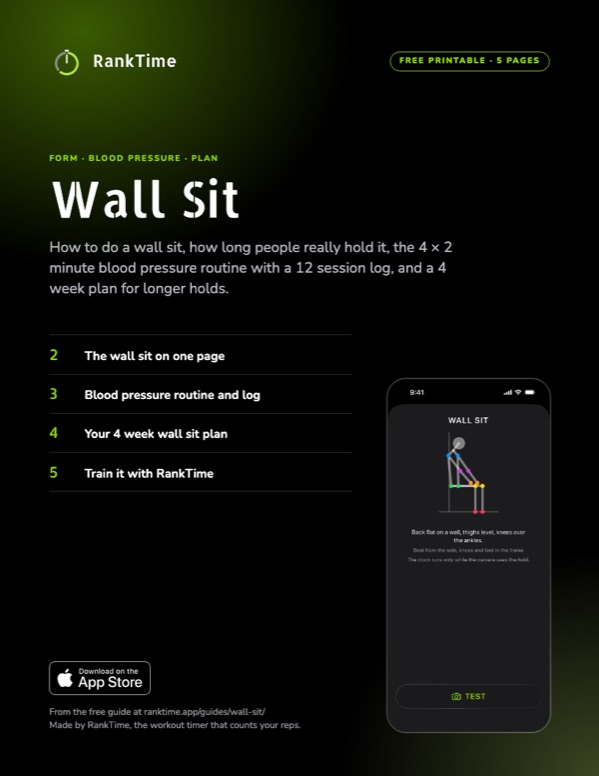
Print it: the wall sit on one page, a blood pressure log and a 4 week plan
Five printable pages: the wall sit on one page, the blood pressure routine with a log for all 12 sessions, and a 4 week plan for longer holds.
Download the free PDF
Time your wall sits with RankTime
A hold clock that runs only while the camera sees you in the wall sit, rests timed for you, and a military rank that grows with every hold.

More guides